 |
The Buddha Preaching in Heaven, Thailand(painting) |
Among India's many ancient Buddhist pilgrimage sites, Sankisa, also known as Sankasya, occupies a unique place in Buddhist tradition. Located in the Farrukhabad district of Uttar Pradesh, Sankisa is revered as the sacred place where Gautama Buddha descended from Tavatimsa Heaven after spending three months teaching the Dhamma to his mother, Queen Mahamaya.
Unlike Lumbini, Bodh Gaya, Sarnath, or Kushinagar—which are directly associated with major events in the Buddha's earthly life—Sankisa commemorates an event deeply rooted in Buddhist tradition and symbolism. Over the centuries, it became a flourishing center of pilgrimage, attracting monks, scholars, emperors, and travelers from across Asia.
Today, its archaeological remains continue to preserve the memory of one of Buddhism's most fascinating sacred sites.
Where is Sankisa?
 |
| Location in india |
Sankisa is situated in Farrukhabad district, Uttar Pradesh, India, approximately 45 km from Farrukhabad city. In ancient Buddhist literature, the site was known as Sankasya.
The town lies in the fertile Gangetic plains and has been identified by archaeologists with the ancient city mentioned in Buddhist texts and the travel accounts of Chinese pilgrims.
The Buddha's Descent from Tavatimsa Heaven
According to Buddhist tradition, after attaining enlightenment, the Buddha traveled to Tavatimsa Heaven during the rainy season retreat.
His purpose was to teach the Abhidhamma to his mother Queen Mahamaya, who had been reborn in the heavenly realm shortly after his birth.
After completing three months of teaching, the Buddha returned to Earth at Sankisa.
Buddhist texts describe this descent as a miraculous event.
It is said that:
- Lord Indra (Sakka) created a golden staircase.
- Brahma created a silver staircase.
- The Buddha descended through the central jeweled staircase.
This event symbolizes the Buddha's compassion not only for humanity but for all beings across different realms of existence.
Emperor Ashoka's Connection with Sankisa
Like many sacred Buddhist sites, Sankisa received royal patronage from Emperor Ashoka during the 3rd century BCE.
Historical evidence indicates that Ashoka erected a monumental stone pillar to commemorate the Buddha's descent.
 |
| Elephant capital at Sankissa, 3rd century BCE |
Although much of the pillar has disappeared over time, its famous elephant capital survives and remains one of the site's greatest archaeological treasures.
Unlike the lion capitals found at Sarnath or Sanchi, the elephant capital of Sankisa carries profound symbolic significance in Buddhism, as the white elephant is closely associated with Queen Mahamaya's dream before the Buddha's birth.
Archaeological Discoveries
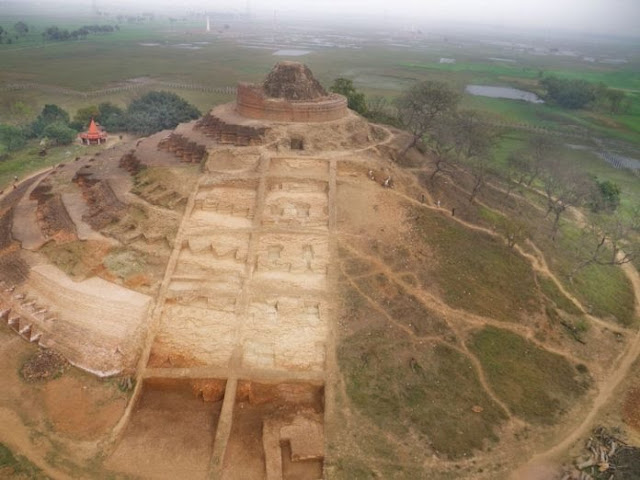
Archaeological excavations have revealed that Sankisa was once a thriving Buddhist religious center.
Excavations uncovered:
- Ancient brick monasteries (Viharas)
- Stupa foundations
- Sculptural fragments
- Terracotta objects
- Coins from different historical periods
- Temple remains
- Stone architectural pieces
- These discoveries indicate continuous occupation over several centuries and demonstrate the importance of Sankisa in the Buddhist world.
Accounts of Chinese Pilgrims
The importance of Sankisa is confirmed by two famous Chinese Buddhist pilgrims.
Faxian visited Sankisa and described the sacred staircase associated with the Buddha's descent.
He also mentioned monasteries and active Buddhist communities around the site.
- Xuanzang (7th Century CE)
Nearly two centuries later, Xuanzang provided a much more detailed description.
He recorded:
- Ashoka's pillar
- Numerous monasteries
- Large stupas
- Buddhist monks living in the area
- Sacred monuments connected with the Buddha's descent
- His account remains one of the most valuable historical sources for reconstructing ancient Sankisa.
Religious Importance
Sankisa is considered one of Buddhism's most sacred pilgrimage destinations.
Pilgrims from:
- Thailand
- Sri Lanka
- Myanmar
- Japan
- Vietnam
- Nepal
- India
continue to visit the site every year.
Many Buddhist traditions also recognize Sankisa among the important places associated with the Buddha's life and miraculous acts.
Present-Day Sankisa
Today, visitors can explore:
- Ashokan Elephant Capital
- Ancient mound
- Excavated monastery remains
- Buddhist temple
- Pilgrimage monuments
- Archaeological landscape
- The site is protected as an important archaeological heritage location and remains a place of spiritual significance for Buddhists worldwide.
Why Sankisa Matters Today
Sankisa is more than an archaeological site.
It represents:
- Compassion
- Wisdom
- Buddhist heritage
- India's ancient civilization
- Cultural continuity
The site reminds us how Buddhist traditions spread across Asia while preserving memories of sacred places connected with the Buddha's life.
Its historical remains, literary references, and enduring religious importance make Sankisa one of India's most remarkable yet lesser-known Buddhist destinations.
Conclusion
Sankisa stands as a remarkable blend of history, archaeology, and Buddhist tradition. From the legendary descent of the Buddha from Tavatimsa Heaven to Emperor Ashoka's commemorative pillar and the detailed accounts of Faxian and Xuanzang, every layer of this ancient site reflects its enduring significance.
For historians, archaeologists, pilgrims, and travelers alike, Sankisa offers a rare opportunity to explore a place where faith, history, and cultural heritage converge. As ongoing preservation efforts continue, this sacred site remains a timeless symbol of India's profound contribution to the Buddhist world.




Comments
Post a Comment