Introduction
Nalanda stands as one of the most remarkable centers of learning in world history. Located in present-day Bihar, India, Nalanda was not only a Buddhist monastery but also the world’s first fully residential international university. For centuries, it attracted scholars, monks, philosophers, and students from across Asia. Its influence extended far beyond the Indian subcontinent, shaping intellectual traditions in Tibet, China, Korea, Japan, and Southeast Asia.
Originally flourishing between the 5th and 12th centuries CE, Nalanda became a beacon of knowledge during the classical age of Indian civilization. In 2026, Nalanda continues to hold immense historical, cultural, and diplomatic significance, especially with the revival of Nalanda University and renewed global interest in the Buddhist heritage of India.
This article explores the historical foundation, academic structure, global influence, decline, rediscovery, and modern revival of Nalanda.
Foundation and Historical Background
Nalanda’s origins can be traced back to the Gupta period, particularly during the reign of Kumaragupta I (circa 415–455 CE). The Gupta era is often referred to as the “Golden Age of India,” marked by remarkable achievements in science, mathematics, literature, and philosophy.
Although the site had earlier religious associations, it was during the Gupta period that Nalanda emerged as a structured monastic university. Over time, it received royal patronage not only from Gupta rulers but also from Harshavardhana (7th century CE) and the Pala dynasty (8th–12th centuries CE), who were strong supporters of Mahayana Buddhism.
Nalanda grew into a massive academic complex that combined monastic life with structured education, creating an advanced institutional model centuries before the rise of European universities.
Architecture and Campus Structure
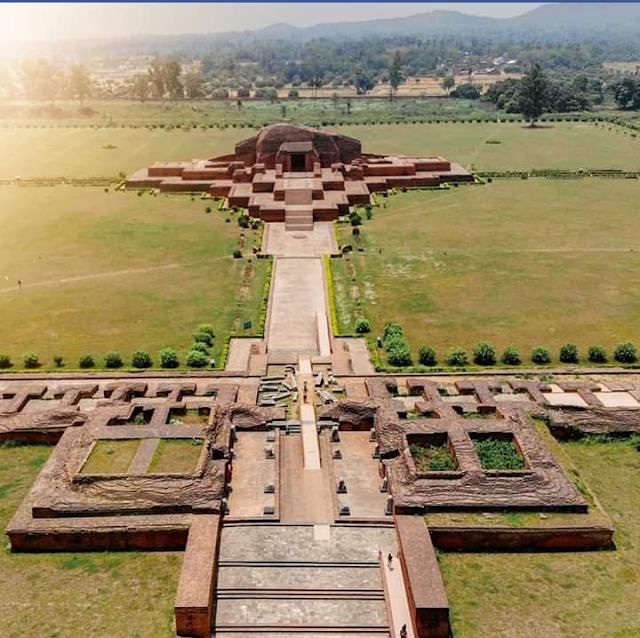
Archaeological excavations reveal that Nalanda was an extensive campus with:
• Multiple monasteries (viharas)
• Large temples and stupas
• Meditation halls
• Lecture rooms
• Residential quarters for thousands of students
• A grand library complex
The campus was built using red bricks, and its architectural design reflected both spiritual symbolism and practical academic planning. Monasteries were arranged around central courtyards, while temples and stupas formed the spiritual core of the institution.
One of the most celebrated features of Nalanda was its vast library complex known as “Dharmaganja” (Treasury of Truth). Historical accounts describe it as having three multi-storey buildings filled with manuscripts on diverse subjects.
Academic Excellence and Curriculum
Nalanda was not limited to religious instruction. It offered a multidisciplinary curriculum that included:
• Buddhist philosophy (Mahayana and later Vajrayana traditions)
• Logic (Hetuvidya)
• Grammar
• Medicine (Ayurveda)
• Astronomy and mathematics
• Metaphysics
• Linguistics
• Art and architecture
Admission to Nalanda was highly competitive. Historical records suggest that entrance examinations were conducted at the main gates, where scholars tested the intellectual capabilities of applicants.
At its peak, Nalanda hosted approximately 10,000 students and 2,000 teachers. The medium of instruction was primarily Sanskrit, and debates were an integral part of the academic culture.
International Influence and Global Scholars
Nalanda’s global reputation attracted students and scholars from across Asia. Among the most famous visitors was the Chinese monk Xuanzang (7th century CE), who spent several years studying and teaching at Nalanda. His detailed travel accounts provide invaluable historical insights into the university’s structure, curriculum, and daily life.
Another important scholar was Yijing, who documented the academic discipline and monastic practices at Nalanda. Through such international exchanges, Nalanda became a major transmitter of Indian philosophy to East Asia.
The university played a central role in the development and spread of Mahayana Buddhism. Many teachers trained at Nalanda later traveled to Tibet, where they laid the foundations of Tibetan Buddhist scholarship.
Patronage Under the Pala Dynasty
The Pala rulers of eastern India were strong supporters of Buddhism and significantly expanded Nalanda between the 8th and 12th centuries CE. During this time, Nalanda became closely associated with Vajrayana Buddhist traditions.
The Palas funded the construction of new monasteries, temples, and educational infrastructure. Nalanda also maintained intellectual connections with other major Buddhist centers such as Vikramashila and Odantapuri.
This era marked the final phase of Nalanda’s peak before its eventual decline.
Destruction and Decline
Nalanda’s decline began in the late 12th century. Around 1193 CE, the Turkish military general Bakhtiyar Khilji invaded parts of Bihar and Bengal. Historical sources state that Nalanda was attacked and set on fire during this campaign.
The destruction of its great libraries symbolized not only the end of an institution but also a major intellectual loss for the region. It is often said that the library burned for months due to the vast number of manuscripts stored within.
Although Buddhism had already begun to decline in parts of India, the fall of Nalanda accelerated the disappearance of organized monastic education in the region.
Rediscovery Through Archaeology
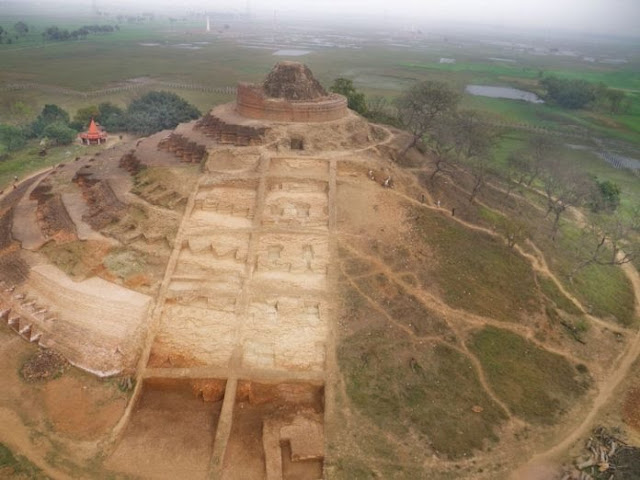
For centuries, Nalanda remained forgotten until systematic archaeological excavations began in the 19th and early 20th centuries under the Archaeological Survey of India.
Excavations revealed an extensive complex of monasteries, temples, sculptures, inscriptions, and seals confirming Nalanda’s historical identity. These discoveries re-established Nalanda as one of the most significant educational institutions of the ancient world.
In 2016, the ruins of Nalanda Mahavihara were inscribed as a UNESCO World Heritage Site, recognizing their outstanding universal value.
Revival of Nalanda University in the Modern Era
In the 21st century, India initiated efforts to revive Nalanda as a symbol of global academic cooperation. The modern Nalanda University was established near the ancient site, inspired by the spirit of international scholarship that once defined the original institution.
As of 2026, the revived university has strengthened academic collaborations with several Asian countries, focusing on sustainable development, Buddhist studies, ecology, and international relations.
Recent developments include:
• Expansion of campus infrastructure
• Increased international student enrollment
• Academic partnerships with Southeast Asian and East Asian institutions
• Growing role in India’s cultural diplomacy under the Buddhist Circuit initiative
Nalanda today serves not only as a historical monument but also as a living symbol of India’s educational heritage.
Nalanda in 2026: Tourism and Cultural Significance
In 2026, Nalanda remains a major destination within the Buddhist Circuit, which includes Bodh Gaya, Rajgir, Vaishali, and Kushinagar. Improved infrastructure, better road connectivity, and heritage conservation projects have contributed to increased domestic and international tourism.
Cultural festivals, academic seminars, and international Buddhist conferences regularly take place in the region, reinforcing Nalanda’s role as a center of dialogue and scholarship.
The site continues to inspire historians, archaeologists, spiritual seekers, and policymakers alike.
Why Nalanda Matters Today
Nalanda represents more than an ancient university. It symbolizes:
• Intellectual openness
• International collaboration
• Academic excellence
• Cultural exchange
• The fusion of spirituality and rational inquiry
Long before modern universities emerged in Europe, Nalanda had already developed a structured residential model with global participation. Its emphasis on debate, research, and interdisciplinary learning makes it a timeless example of higher education.
In the modern era, when global cooperation and knowledge-sharing are more important than ever, Nalanda’s legacy offers valuable lessons.
Conclusion
Nalanda stands as one of the greatest achievements of ancient Indian civilization. From its foundation during the Gupta period to its peak under the Pala dynasty, Nalanda shaped Buddhist philosophy and global intellectual traditions for centuries.
Though destroyed in the 12th century, its rediscovery and modern revival ensure that its legacy continues to inspire the world. In 2026, Nalanda is not merely a historical ruin; it is a powerful symbol of India’s enduring commitment to knowledge, dialogue, and cultural exchange.
The story of Nalanda is a reminder that education, when supported by openness and vision, can transcend time and geography.




Comments
Post a Comment