Mes Aynak: Afghanistan's Ancient Buddhist Site Threatened by Copper Mining (2025 Updates)

Image
  In the rugged mountains of Logar Province, just 40 kilometers southeast of Kabul, lies Mes Aynak – one of Afghanistan's most significant ancient Buddhist sites. Often called a "little copper spring" in Pashto, this sprawling archaeological treasure was once a thriving Buddhist monastery complex along the Silk Road. Dating back over 2,000 years to the Kushan Empire, Mes Aynak features massive stupas, intricate Buddha statues, and evidence of early copper mining intertwined with monastic life. But in 2025, this ancient Buddhist heritage site in Afghanistan faces an ongoing threat from one of the world's largest untapped copper deposits below it. In this detailed guide, we'll explore the history of Mes Aynak Buddhist site, its breathtaking discoveries, and the latest developments in the battle to save it. Aerial view of Mes Aynak ancient Buddhist ruins in Afghanistan, showing the vast monastery complex amid mountains. Location and Historical Significance of ...

Nalanda: an oldest Buddhist university

The establishment of ancient  nalanda as an undisputed seat of learning was a historical consequences of its context. Ancient magadha was characterized by an intellectual ferment unlike any know to humanity.
Historical sources indicat that the university had a long and illustrations life which lasted almost continually for 800 years from the fifth to twelfth century CE. It was a completely residential university believed to have 2000 teachers and 10000 students.Nalanda was initially a prosperous village by a major trade route that ran through the nearby city of rajagriha which was then the capital of magadha.
Nalanda was an ancient Mahavira, a large number of Buddhist monetary in this Mahavira. Nalanda is located in bihar, bihar Sharif it was an important learning center in ancient time.
Nalanda flourished under the patronage of Gupta empire in 5th and 6th century. 
At its peak the school attracts scholars and students from near and far, with some travelling from tibet, China, Korea and central Asia. From Indonesian shailendra dynasty also built a monetary in nalanda complex .
Many pilgrim monk such as xuanzang and yijin  come from China in 7th century. Many students at nalanda studied mahayan, as well as the text of the eighteen sects of Buddhism. Jain thirthankara, Mahavira spent 14 rainy seasons at nalanda .
A statue of Gautama buddha at nalanda -----
Add caption
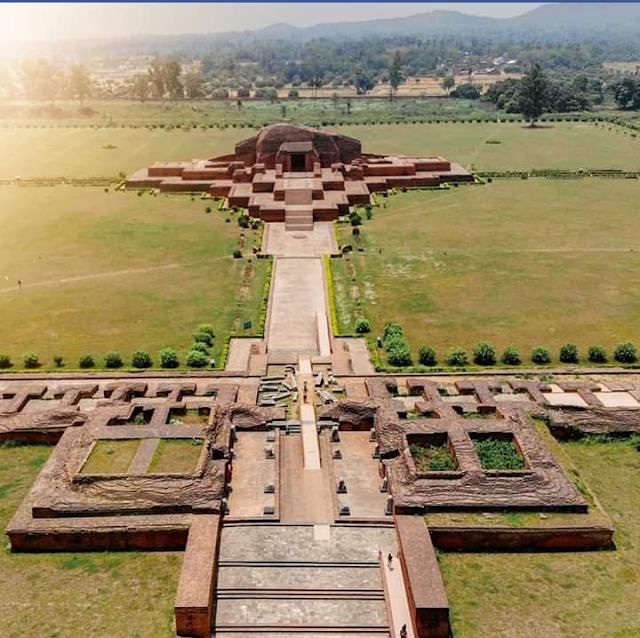
After its decline, nalanda was largely forgotten until Francis Buchanan Hamilton surveyed the site in 1811- 1812. The remained of nalanda today extended some 1600 feet north to south and around 800 feet east to west. Excavations have revealed eleven monasteries and six major brick temple arranged ordered layout.
 Nalanda was destroyed thrice. 
Nalanda was destroyed by an army of mamluk dynasty of the Delhi sultanate under bakhtiyar khilji.
 On 25 November 2010 the Indian government,through an act of Indian Parliament resurrected the ancient university through the nalanda university bill and subsequently a new nalanda university was establishment. 

Comments

Popular posts from this blog

conversation between buddha and ananda.

Vikramshila university destroyed by an Islamic invader

cultural sites damaged by ISIS

Kusinagar: Where Buddha Slipped his Earthly Bonds.

Kesaria stupa: world's largest buddhist stupa.