Vaishya Tekri Ujjain: The Mysterious Ancient Stupa That May Be Larger Than Sanchi

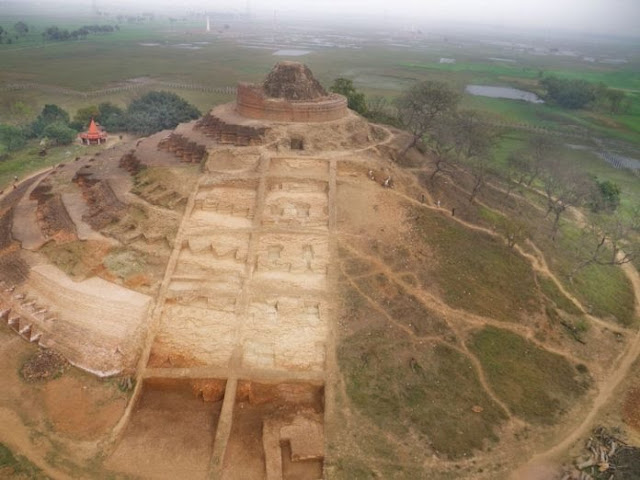
For nearly nine decades, a massive archaeological mound near Ujjain has remained only partially understood. Known as Vaishya Tekri, the site was excavated in 1938–39, when archaeologists identified the remains of an unusually large monument believed to be a Buddhist stupa.
Now, after almost 90 years, the site has returned to the archaeological spotlight. The Archaeological Survey of India (ASI) and the Madhya Pradesh government are pursuing renewed investigation and excavation at Vaishya Tekri.
The most striking claim comes from the old excavation record: the monument was estimated to have a base of around 350 feet in diameter and a height of at least 100 feet. For comparison, the present Great Stupa at Sanchi is about 54 feet high. However, whether Vaishya Tekri was actually larger than Sanchi—and whether it was specifically built under Emperor Ashoka—still requires scientific verification.
What Is Vaishya Tekri?
Vaishya Tekri is an ancient archaeological mound at Undasa in Ujjain district, Madhya Pradesh. Importantly, the current ASI list does not officially describe it as an “Ashokan Stupa.” It records the protected monument more cautiously as “Ancient Mound (Vaishya Tekri)”. A nearby monument is separately listed as Ancient Mound (Kumbhar Tekri).
The mound is nevertheless associated with a major Buddhist structure because of evidence recorded during the first excavation.
Ujjain itself was one of ancient central India’s most important cities. Known as Ujjayini, it was the capital of Avanti and an important commercial centre connecting the northern Indian heartland with western India. Its importance during the Mauryan period makes the archaeological remains around the city particularly significant.

The 1938–39 Excavation
The first systematic excavation of Vaishya Tekri was carried out in 1938–39 by the Archaeological Department of the former Gwalior State.
The excavation report, preserved in the annual administration records of the Gwalior State archaeological department, described the mound as a huge stupa and recorded several unusual construction features.
According to the historical report, the monument had an estimated base diameter of approximately 350 feet and a height of not less than 100 feet.
But the excavators also recorded an important limitation: much of the original outer facing had disappeared, making it impossible to reconstruct the exact original plan and elevation with certainty. Therefore, the 100-foot figure should be understood as an archaeological estimate rather than the height of a completely preserved monument.
An Unusual Construction Technique
One of the most fascinating aspects of Vaishya Tekri is its engineering.
The core of the monument was not simply a solid mass of brickwork. The old excavation report described a massive core made from locally available blackish murum, compacted to create a strong foundation. Brick masonry was then used as the outer facing.
The excavators also identified an unusual arrangement at the lower part of the monument. The masonry was constructed in a bowl-like form, apparently designed to support the enormous weight of the superstructure and counter the outward pressure produced by the massive filling above it.
This engineering detail makes Vaishya Tekri important not merely because of its size, but also because it may provide evidence for experimentation in early monumental construction.

A Moat and a Possible Processional Approach
The archaeological remains around the mound offered another intriguing clue.
Material was apparently quarried from around the monument, creating a roughly square depression resembling a moat. On the western side, excavators identified remains of a passage crossing this depression.
The old interpretation was that this passage may have provided access for worshippers approaching the monument from the direction of the ancient settlement.
If this interpretation is confirmed by modern excavation, it could help archaeologists reconstruct how the stupa was approached and used rather than viewing it simply as an isolated mound.
Was Vaishya Tekri Built by Emperor Ashoka?
This is where the story becomes more complicated.
Vaishya Tekri is frequently described in popular reports as an Ashokan stupa, but the evidence does not yet establish direct Ashokan authorship.
The 1938–39 excavation produced large bricks and coins, including punch-marked material, which encouraged the original excavators to associate the monument with the Mauryan period. Its location in ancient Ujjain further strengthened the possibility of a Mauryan connection.
However, an important distinction must be made:
Mauryan-period association does not automatically prove that Emperor Ashoka commissioned the monument.
No securely reported inscription naming Ashoka as the builder has been cited from the monument. Nor has a securely documented relic deposit or donor inscription established direct royal patronage.
Modern researchers have therefore urged caution and called for investigation beyond the limited 1938–39 excavation.

Is Vaishya Tekri Really Bigger Than Sanchi?
This is probably the question that has attracted the most attention.
The old report estimated Vaishya Tekri at approximately 350 feet across and at least 100 feet high, while the present Great Stupa at Sanchi is around 54 feet high. On these figures alone, Vaishya Tekri appears considerably larger.
But a direct comparison requires caution.
The Vaishya Tekri monument is heavily damaged and its original plan and elevation could not be fully reconstructed during the early excavation. Sanchi, meanwhile, represents a monument with several phases of construction and modification over centuries.
Therefore, the accurate statement is not that archaeologists have definitively discovered a stupa larger than Sanchi.
The accurate statement is:
The 1938–39 excavation report recorded dimensions that, if confirmed by modern research, could make Vaishya Tekri larger than the present Great Stupa at Sanchi.

Why Is the New Excavation Important?
The renewed investigation could answer questions that the 1938–39 excavation could not.
Modern archaeology can combine excavation with detailed surveying, stratigraphy, material analysis, numismatics, conservation science and scientific dating.
Researchers will need to establish:
● The precise date of the earliest construction
● Whether the monument has multiple construction phases
● Its original architectural plan
● The relationship between Vaishya Tekri and nearby Kumbhar Tekri
● Whether associated monasteries or smaller stupas existed nearby
● Whether any inscription or relic deposit survives
● How the monument relates to ancient Ujjain
● Whether the Ashokan attribution can actually be demonstrated
The ASI has indicated that meaningful excavation could take several years, while restoration would be an additional challenge.



Comments
Post a Comment