Imagine a time when thousands of students from China, Tibet, Korea, Sri Lanka, Southeast Asia, and Central Asia traveled thousands of kilometers—not to Europe, but to India. They crossed mountains, deserts, and forests in search of wisdom at some of the world's oldest universities.
Long before modern universities appeared, ancient India was home to remarkable Buddhist centers of higher education. These institutions were far more than monasteries. They served as international universities where philosophy, medicine, astronomy, grammar, mathematics, logic, literature, and Buddhist studies were taught by renowned scholars.
Although many of these universities were eventually destroyed or abandoned, archaeological discoveries continue to reveal their extraordinary history. Today, their ruins stand as silent reminders of an intellectual tradition that shaped Asia for centuries.
This article explores the history, architecture, archaeological discoveries, and enduring legacy of the lost Buddhist universities of ancient India.
Why Buddhist Universities Were Unique
Unlike ordinary monasteries, Buddhist universities welcomed students from many regions and cultures. Admission was often difficult, requiring candidates to demonstrate their knowledge before being accepted.
Learning combined classroom discussions, debates, meditation, manuscript study, and practical instruction.
 |
| Buddhist university in ancient India |
Libraries preserved thousands of handwritten texts on palm leaves, while scholars translated important works into Chinese, Tibetan, and other languages, helping spread knowledge across Asia.
These universities became cultural bridges connecting India with the wider Buddhist world.
1. Nalanda Mahavihara – The World's Greatest Buddhist University
Among all Buddhist universities, Nalanda was undoubtedly the most influential.
Founded during the Gupta period, probably in the 5th century CE, Nalanda flourished under later rulers, especially the Pala dynasty. At its peak, it attracted thousands of students and teachers from across Asia.
Chinese pilgrim Xuanzang spent several years studying here during the 7th century and described Nalanda as a vast academic community where only highly qualified students gained admission. Another Chinese monk, Yijing, also praised the university's disciplined education and scholarly environment.
Academic Subjects
- Students studied:
- Buddhist philosophy
- Sanskrit grammar
- Logic
- Medicine
- Astronomy
- Mathematics
- Linguistics
- Ethics
- Literature
Architectural Features
Excavations reveal an impressive campus consisting of:
- Large monasteries (Viharas)
- Temples (Chaityas)
- Lecture halls
- Meditation spaces
- Brick courtyards
- Wells
- Beautiful sculptures
- Massive libraries
Today, the ruins of Nalanda are recognized as a UNESCO World Heritage Site and remain one of India's greatest archaeological treasures.
2. Vikramashila Mahavihara – The University of Advanced Buddhist Learning
When the quality of education at Nalanda required reinforcement, the Pala king Dharmapala established Vikramashila during the late 8th century CE.
Located in present-day Bihar, Vikramashila became famous for advanced Buddhist philosophy, especially Vajrayana traditions.
Its scholars traveled widely across Tibet and played an important role in preserving Indian Buddhist teachings.
The celebrated teacher Atisha Dipankara, whose influence transformed Tibetan Buddhism, studied and taught here before traveling to Tibet.
Excavations
Archaeological excavations have uncovered:
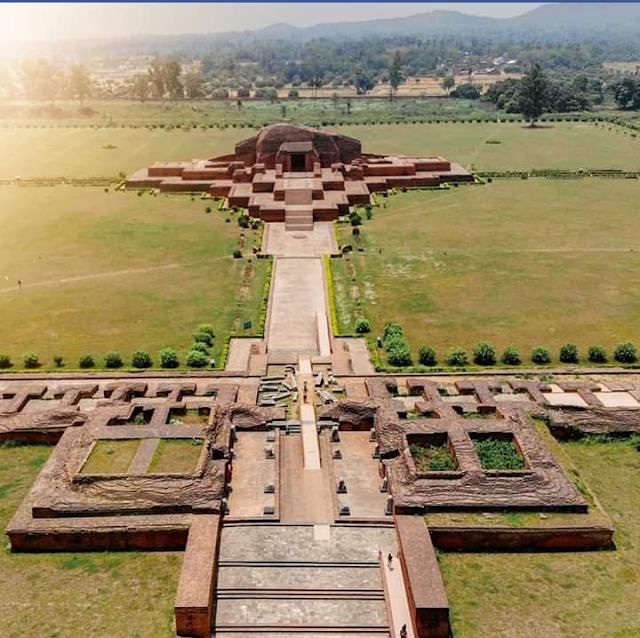
A magnificent cruciform stupa
Monastic cells
Prayer halls
Terracotta plaques
Stone sculptures
Drainage systems
Brick pathways
These discoveries reveal a carefully planned educational complex.
Odantapuri was another important university established under the Pala rulers, probably during the reign of King Gopala.
Although less famous than Nalanda, historical records suggest it was one of eastern India's major Buddhist learning centers.
Many Tibetan sources describe Odantapuri as an influential institution where monks received advanced education before traveling to Nepal and Tibet.
Unfortunately, much of the site remains buried beneath modern settlements, making archaeological research challenging. Even so, historians believe Odantapuri played a vital role in preserving Buddhist scholarship during the early medieval period.
Jagaddala emerged during the later Pala period and became especially important for manuscript production and translation.
Scholars at Jagaddala translated numerous Buddhist texts into Tibetan, helping preserve Indian Buddhist philosophy after Buddhism gradually declined in northern India.
Although only limited archaeological remains survive today, historical evidence indicates that Jagaddala maintained close scholarly relationships with other universities such as Nalanda and Vikramashila.
Its contribution to Buddhist literature remains significant because many Sanskrit works survived only through Tibetan translations produced by scholars associated with institutions like Jagaddala.
5. Somapura Mahavihara – A Masterpiece of Buddhist Architecture
Somapura Mahavihara, located in present-day Bangladesh, was one of the largest Buddhist monasteries ever constructed in South Asia.
Built during the Pala Empire, its enormous square layout surrounded a magnificent central shrine.
The monastery influenced Buddhist architecture across Myanmar, Java, Cambodia, and other parts of Southeast Asia.
Excavations have revealed:
Monastic cells
Decorative terracotta plaques
Sculptures
Courtyards
Drainage systems
Religious structures
Today, Somapura is also recognized as a UNESCO World Heritage Site.
How Students Lived
Life at these universities followed a disciplined routine.
Students woke before sunrise for meditation and prayers. Classes included lectures, debates, memorization, and discussions with teachers. Libraries served as the intellectual heart of the campus, where handwritten manuscripts were carefully copied and preserved.
Food and accommodation were usually provided by the monastery through royal patronage and public donations, allowing students to focus entirely on learning.
Libraries That Preserved Knowledge
The libraries of Buddhist universities were among the greatest collections of knowledge in the ancient world.
Besides Buddhist scriptures, they contained works on:
- Medicine
- Astronomy
- Mathematics
- Grammar
- Philosophy
- Logic
- Poetry
- Linguistics
- Art
Many manuscripts later reached Tibet, China, and Southeast Asia, where they survived even after the original Indian libraries disappeared.
Why These Universities Declined
The decline of Buddhist universities was gradual rather than sudden.
Several factors contributed:
- Declining royal patronage
- Political instability
- Regional conflicts
- Changing religious landscape
- Invasions during the late 12th and early 13th centuries
Historical sources describe the destruction of major institutions such as Nalanda, Vikramashila, and Odantapuri during military campaigns led by Bakhtiyar Khalji. However, Buddhism had already begun declining in several parts of India before these events.
Despite the destruction of many buildings, the intellectual traditions continued through scholars who carried manuscripts and teachings to Nepal, Tibet, Sri Lanka, and Southeast Asia.
Archaeology Continues to Reveal Their Story
Excavations conducted over the past century have transformed our understanding of these universities.
Archaeologists have uncovered:
- Brick monasteries
- Stone sculptures
- Seals
- Copper plates
- Terracotta plaques
- Coins
- Pottery
- Temple foundations
- Ancient drainage systems
- Monastic courtyards
These discoveries demonstrate that the universities were carefully planned educational cities rather than isolated monasteries.
Modern archaeological research continues to improve our understanding of student life, architecture, and intellectual traditions.
Legacy of the Lost Universities
The influence of these universities extends far beyond India.
Their graduates helped spread Buddhism throughout Asia. Their translations preserved countless Sanskrit works that might otherwise have disappeared forever.
Modern universities often celebrate innovation and international education, yet these principles flourished in ancient India more than a thousand years ago.
Today, the ruins of Nalanda, Vikramashila, Somapura, and other historic institutions remind us that education has long been a powerful force for cultural exchange, peaceful dialogue, and human progress.
Conclusion
The lost Buddhist universities of ancient India were not merely centers of religion; they were among humanity's earliest international institutions of higher learning. Their scholars advanced philosophy, science, language, medicine, and cultural exchange while shaping the intellectual history of Asia.
Although many of these universities now survive only as archaeological ruins, their ideas continue to inspire researchers, historians, and travelers around the world. Every excavated brick, manuscript fragment, and sculpture tells the story of a civilization that believed knowledge was one of humanity's greatest treasures.
For anyone interested in Buddhism, archaeology, or ancient education, the legacy of these remarkable universities remains as relevant today as it was over a thousand years ago.




Thank you for sharing this fascinating article about the lost Buddhist universities of ancient India. I appreciated how it explores the history, intellectual achievements, and archaeological remains of these great centers of Buddhist learning. Places such as Nalanda, Vikramashila, and other ancient institutions played an important role in preserving, developing, and spreading Buddhist philosophy, literature, and knowledge across Asia.
ReplyDeleteThe article is a meaningful reminder of India's remarkable Buddhist heritage and the importance of protecting its archaeological sites. Thank you for highlighting these forgotten centers of learning and helping readers appreciate their enduring contribution to Buddhist education, culture, and the wider history of Asia.
Regards,
Antique Buddhas
https://www.antique-singing-bowls.com