India is home to hundreds of Buddhist monuments, but only a handful receive widespread attention. While places such as Sanchi, Nalanda, Bodh Gaya, and Amaravati are well known, the ancient Buddhist settlement of Phanigiri remains one of the country's most remarkable yet underrated archaeological treasures. Situated in the Suryapet district of Telangana, this hilltop complex preserves the remains of a flourishing Buddhist establishment that existed for several centuries and played an important role in the spread of Buddhism across the Deccan.
Excavations have revealed impressive stupas, monasteries, prayer halls, inscriptions, sculptures, and Buddhist relics, providing valuable evidence of religious, educational, and artistic activities in southern India. Today, Phanigiri stands as a silent witness to a vibrant Buddhist civilization that once attracted monks, pilgrims, merchants, and patrons from different regions.
This article explores the history, archaeology, architecture, and cultural importance of Phanigiri based on historical research and archaeological discoveries.
Where is Phanigiri Located?
Phanigiri is located in Suryapet District, Telangana, approximately 110 kilometers from Hyderabad. The archaeological remains occupy a hill overlooking the surrounding plains, a location that offered strategic advantages while also creating a peaceful environment suitable for monastic life.
The name Phanigiri comes from two Sanskrit words:
Phani – serpent
Giri – hill
The hill resembles the hood of a cobra when viewed from a distance, giving rise to its traditional name.
Like many Buddhist monasteries across ancient India, Phanigiri was established on elevated ground, combining isolation for meditation with accessibility for pilgrims traveling along regional trade routes.
Historical Background
Archaeological evidence indicates that Phanigiri flourished between the 2nd century BCE and the 4th century CE, although some structures continued to receive patronage in later centuries.
This period witnessed the rapid expansion of Buddhism throughout the Deccan under the patronage of regional dynasties and wealthy merchants. Southern India had become an important crossroads connecting northern India with coastal ports involved in international trade.
The prosperity generated through commerce enabled monasteries to receive generous donations, resulting in the construction of elaborate religious complexes.
Phanigiri developed during this dynamic historical period and gradually became one of the major Buddhist centers in present-day Telangana.
A Major Buddhist Monastic Centre
Excavations reveal that Phanigiri was far more than a simple temple.
It functioned as a complete Buddhist monastic settlement containing:
- Residential monasteries (Viharas)
- Prayer halls (Chaityas)
- Large ceremonial stupas
- Water management systems
- Meditation spaces
- Assembly areas
- Religious sculptures
- Inscribed stone monuments
The layout demonstrates careful planning, suggesting that hundreds of monks may have lived, studied, and practiced Buddhism here over several generations.
The site reflects the organized nature of Buddhist institutions during ancient India.
The Magnificent Mahastupa
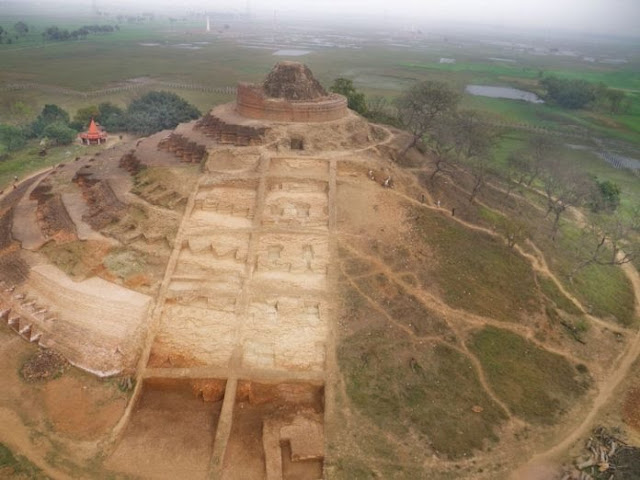
The centerpiece of Phanigiri is its impressive Mahastupa, one of the largest Buddhist stupas discovered in Telangana.
Unlike ordinary commemorative monuments, stupas served as sacred structures preserving relics and symbolizing the Buddha's enlightenment.
The Mahastupa at Phanigiri occupies a commanding position on the hilltop, making it visible from considerable distances.
Archaeologists believe pilgrims once circumambulated the stupa while offering flowers, lamps, and prayers.
The architecture demonstrates sophisticated engineering and artistic planning, reflecting the prosperity enjoyed by the monastery.
Chaitya Halls: Sacred Spaces for Worship
One of Phanigiri's most distinctive features is the presence of apsidal Chaitya halls.
These prayer halls allowed monks and lay followers to gather for collective worship, chanting, and religious ceremonies.
Their design closely resembles early Buddhist architecture seen in western India, showing that architectural ideas traveled across different Buddhist regions.
The chaityas also illustrate how Buddhist communities developed regional variations while maintaining common religious traditions.
Buddhist Footprints (Buddhapada)
Among the most significant discoveries are carved Buddhapada, or footprints of the Buddha.
Before Buddha images became common, many Buddhist communities represented the Buddha symbolically through:
- Empty throne
- Bodhi tree
- Dharma wheel
- Footprints
The footprints at Phanigiri belong to this important artistic tradition and help scholars understand the evolution of Buddhist iconography.
Archaeological Excavations
Systematic excavations conducted by the Department of Archaeology of Telangana have transformed our understanding of Phanigiri.
Archaeologists uncovered:
- Monumental stupas
- Votive stupas
- Stone railings
- Sculptures
- Brahmi inscriptions
- Coins
- Stucco decorations
- Pottery
- Ritual objects
- Structural foundations
Each discovery contributes valuable information about Buddhist society in southern India.
Inscriptions and Historical Evidence
Stone inscriptions discovered at Phanigiri are among its most valuable historical sources.
Written primarily in Brahmi script, they record donations made by monks, merchants, women devotees, and local elites.
These inscriptions reveal that Buddhist monasteries depended on community support rather than royal patronage alone.
The records also provide important evidence regarding ancient languages, social organization, and religious practices.
Decline of the Monastery
Like many Buddhist institutions in India, Phanigiri gradually declined between the late first millennium and the early second millennium CE.
Historians attribute this decline to several interconnected factors:
- Changing political patronage
- Transformation of trade networks
- Rise of other religious institutions
- Economic changes
There is no evidence that a single event caused its abandonment. Instead, the process appears to have been gradual over several centuries.
Why Phanigiri Matters Today
Phanigiri is not merely an archaeological site.
It preserves evidence of:
- Ancient education
- Religious tolerance
- Architectural innovation
- Artistic excellence
- Community-supported monastic life
- The spread of Buddhism in southern India
For historians and archaeologists, the site provides an invaluable window into the social and religious history of the Deccan.
Conclusion
Phanigiri stands among the most significant Buddhist archaeological sites in southern India. Its monumental stupa, carefully planned monasteries, ancient inscriptions, symbolic Buddhist art, and evidence of organized religious life make it an essential destination for anyone interested in the history of Buddhism.
Although it remains less famous than Sanchi or Nalanda, ongoing archaeological research continues to demonstrate that Phanigiri played a meaningful role in the religious, educational, and cultural development of the Deccan. Preserving and studying this remarkable hilltop monastery ensures that the legacy of ancient Buddhist civilization will continue to inspire future generations.




Comments
Post a Comment